
Charleston County Criminal Court Cases
The Court of General Sessions is the criminal session of South Carolina Circuit Court. It hears felonies and other matters assigned by law in Charleston County, part of the Ninth Judicial Circuit. Magistrate courts and municipal courts hear their own lesser criminal, traffic, and ordinance cases. That division affects the first place to search. A felony case is likely to appear through the Charleston County Clerk of Court, while a city summons may remain with the city court that handled it.
The clerk is the custodian of the official court file. The Circuit Solicitor is the elected prosecutor, and a Solicitor search result or recommendation is not the court's final judgment. Case numbers, indictment numbers, and agency report numbers also serve different purposes. Use the court case number for the clerk's file, the indictment number for the grand jury charge, and the agency number when seeking the police narrative.
Charleston County Court Jurisdiction
County criminal records are split by court level. General Sessions sits in the Charleston County court system at the Judicial Center, while each municipal court controls its own assigned docket. Only participating municipal courts feed the statewide Public Index. A blank county-index result may mean the case belongs to a municipal court, not that no charge was filed.
The official North Charleston Municipal Court page shows one such separate court channel.
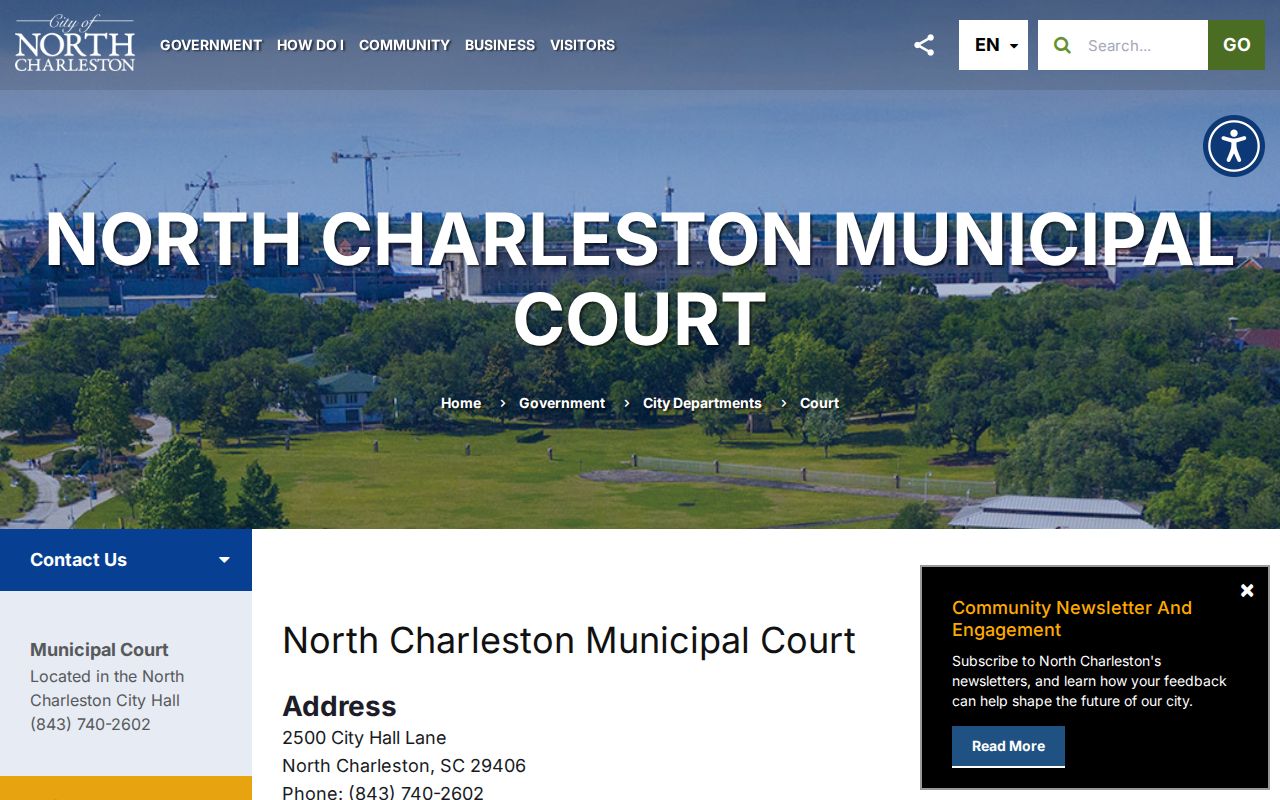
That court handles city matters within its jurisdiction, so searchers should not assume every North Charleston charge will surface in the county view.
Searching Charleston County Case Records
The free Charleston Public Index is the main online starting point for filed Charleston County cases. Enable JavaScript, cookies, and pop-ups before searching. The index provides basic party, filing, document-index, event, and disposition data when a public case is available. It does not make juvenile, adoption, abuse and neglect, or termination matters public. The Judicial Branch also stopped showing home addresses in all cases on January 1, 2026.
- Open the Charleston Public Index and select the court record search.
- Search with the exact party spelling or a known court case number.
- Compare the filed date, court agency, case type, and source number to the event you seek.
- Read status and disposition separately from the charged offense and docket schedule.
- Ask the Clerk for an older file, a missing public entry, or a certified copy.
The Charleston Public Index interface is the official county case-search entry shown here.
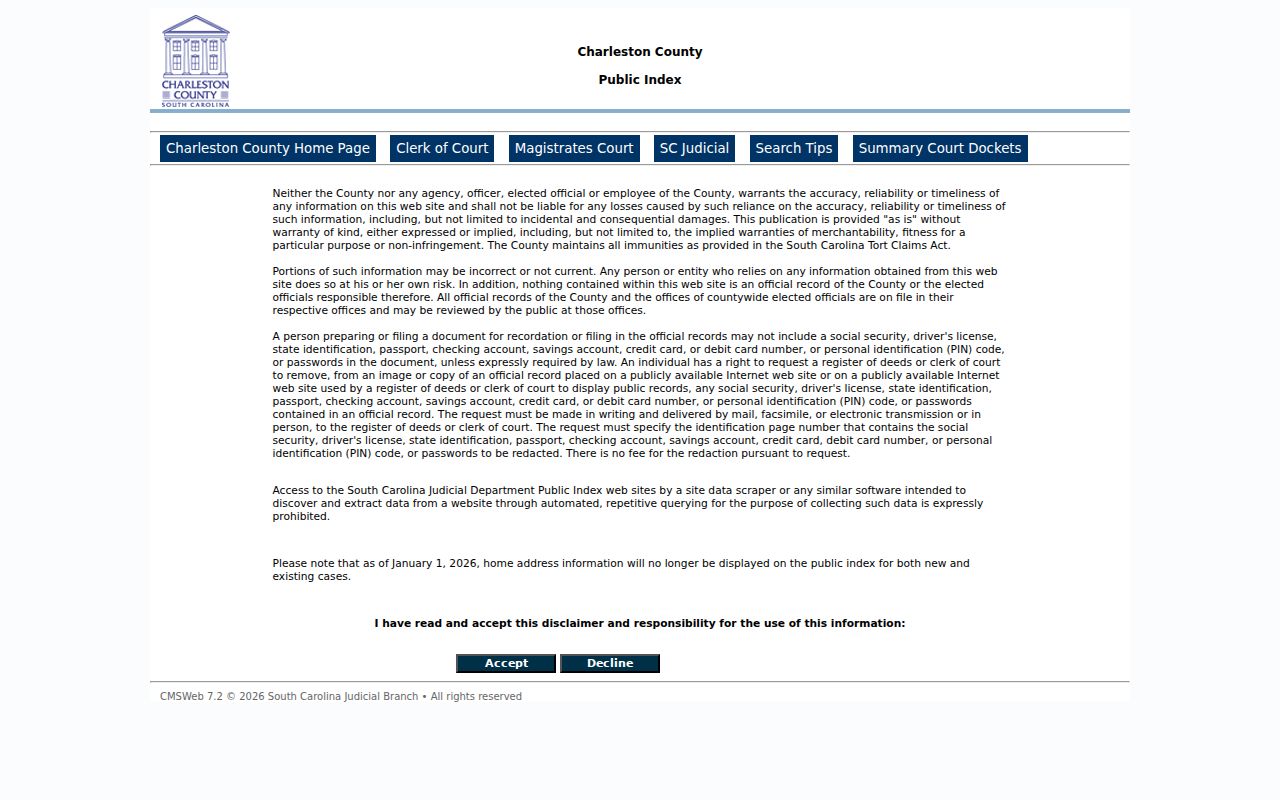
Use its result as a locator, then obtain a clerk-authenticated copy when the exact content of an order matters.
| Field or Control | Type | Required | Use |
|---|---|---|---|
| Party name | Text | No single field confirmed | Use exact spelling and compare identifiers |
| Case number | Text | No | Best route to one known clerk file |
| Filed date | Record field | No | Marks court receipt, not arrest date |
| Court agency/type | Record field | No | Confirms the court and case category |
| Status/disposition | Record field | No | Read these apart from the listed charge |
Charleston Court Search Channels
Public Index, the Ninth Circuit Trial Docket, and the Solicitor's case tool answer different questions. Public Index is the official online starting point for filed cases. The trial docket is a courtesy schedule that may change. Solicitor notes can show prosecutorial activity or a recommendation, but they are not the judgment. The Clerk's file controls when those views differ.
The Ninth Circuit Trial Docket allows a county, docket date, and assigned judge selection.
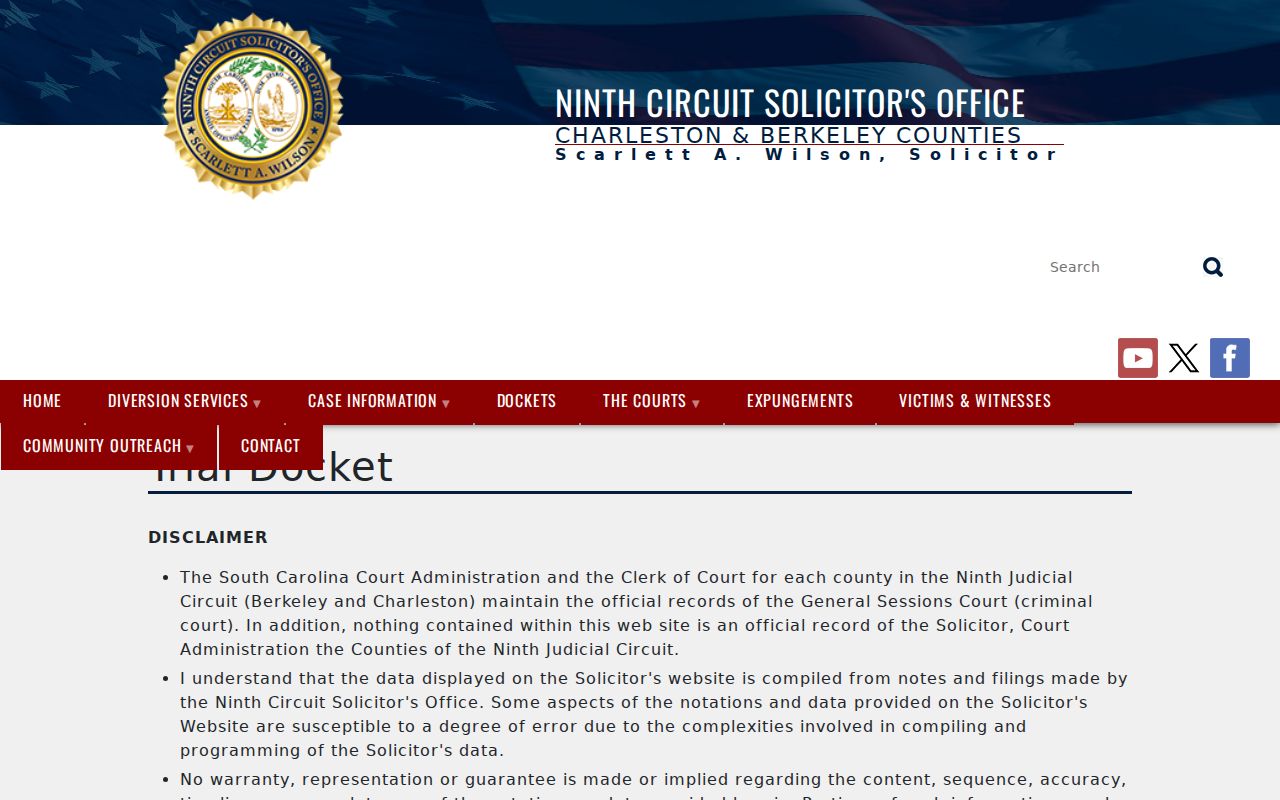
Its rows may show a defendant, case and indictment numbers, arrest date, indicted charge, counsel, judge, status, and comments, but the schedule does not prove the event occurred as listed.
| Channel | Best use | Main limit |
|---|---|---|
| Public Index | Filed case and event history | Restricted cases and some municipal matters absent |
| Trial Docket | General Sessions schedule by date or judge | Courtesy data may be stale |
| Solicitor search | Prosecution-side status or recommendation | Not the official judgment |
| Clerk counter | Older, certified, or raised-seal copies | Copy and retrieval fees may apply |
Inside a Charleston County Case File
A court file records adjudication, not just custody. Charleston County fields may include case and indictment numbers, the arrest date, filed date, court agency, case type and subtype, the indicted charge, attorneys, judge, events, status, disposition and date, judgment number, financial entries, and the court roster. Documents, hearing detail, and financial data vary by case, so an online summary should never be treated as a promise that every document can be downloaded.
| Case Number and Court | Identifies the clerk file and court agency that owns it. |
|---|---|
| Charging Document | May be a complaint, warrant, or indictment; an accusation is not a finding of guilt. |
| Docket Entries | Show filed events and procedural activity in date order. |
| Hearing Dates | List scheduled or recorded court events, subject to later change. |
| Disposition and Judgment | State the court's recorded outcome and any linked judgment data. |
| Sentence and Conditions | Appear after conviction when entered and available in the public file. |
Note: “Disposed” means an outcome was entered; it does not by itself mean the defendant was convicted.
Charleston County Indicted Charges
An indicted charge is the offense approved by a grand jury through a true bill. It may differ from the offense named at arrest because the Solicitor reviews the evidence before presenting a charge. A no bill means the grand jury did not approve the indictment. Neither the arrest charge nor the indicted charge should be read alone as the case result.
Read across the file. “Pending” means no final outcome is recorded in that system at that time. “Nolle prosequi” means the prosecutor ended that charge. “Dismissed Not Indicted” reflects a different nonconviction path, while “not guilty” is an acquittal. Each term tells a distinct part of the Charleston County court history, and expungement is a separate process even after a qualifying result.
- Indictment
- The grand jury's formal charging instrument.
- True bill
- Grand jury approval of the proposed indictment.
- No bill
- Grand jury decision not to approve that indictment.
- Nolle prosequi
- The Solicitor's formal choice not to continue the charge.
- Disposition
- The final recorded result of the charge or case.
How a Criminal Case Moves
A Charleston County case may begin with investigation and arrest, followed by a bond or initial appearance. A complaint or warrant starts the lower-court process. A preliminary hearing may follow. The Circuit Solicitor then reviews the matter and may present it to the grand jury. General Sessions handles arraignment, pretrial work, a plea or trial, sentencing, and any later appeal steps that apply.
Case flow: Charges Filed › Arraignment › Pretrial › Plea or Trial › Disposition › Sentencing
The flow is not a fixed clock. A docket date can move, a charge can change, and more than one charge can end in different outcomes. Check the latest clerk entry before relying on a scheduled event. For the earlier custody record, the county's arrest lookup channels identify the booking and arresting agency.
Charleston Drug Court Records
Charleston County Drug Court brings the judge, Circuit Solicitor, Public Defender, treatment staff, probation staff, and court staff into one program. Successful completion can lead to dismissal. Noncompliance, new charges, repeated positive tests, violence, disappearance, or failure to attend can change the path and may lead to a bench warrant. Program participation therefore needs to be read with the case docket, not as a stand-alone promise of dismissal.
The Ninth Circuit Solicitor describes local programs and prosecution services. Its information can help explain why a case has a program-related event. Still, only the clerk's disposition and signed orders settle what the court entered. When a Charleston County case appears open after a claimed completion, preserve the case number and ask the Clerk to confirm the official record.
Correcting Charleston County Court Records
When an online entry seems wrong, save the Charleston County case number, the exact field, and the displayed date. Contact the Clerk or the municipal court that owns the official case. A mismatch in CATCH belongs to SLED's correction process, while a wrong booking field may require both CCSO and the arresting agency. Those channels should not be blended because each custodian controls a different record.
The North Charleston criminal portal shows why the owning court matters. Its official eCourt criminal lookup uses a courtesy summons, ticket, or warrant number, plus driver-license and birth-date identifiers rather than a broad name search.
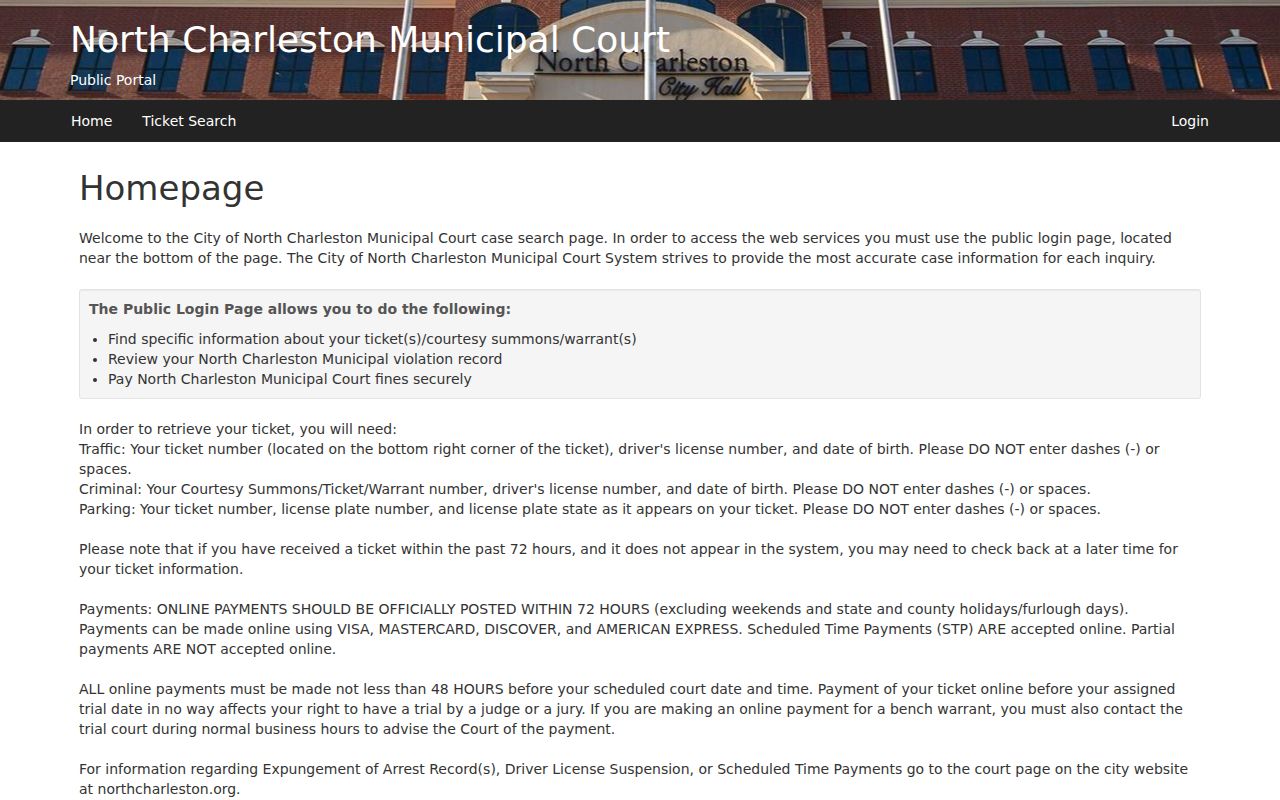
An absent result there can reflect an identifier error or posting lag, so contact the municipal court before treating it as a dismissal.
Case Record Access & Restrictions
The South Carolina Freedom of Information Act supports access to public records, but it does not make every court detail open, free, instant, or unredacted. Juvenile, adoption, abuse and neglect, and termination cases are not available through the public online index. Protected identifiers and victim information may also be redacted. A missing case can result from those limits or from a municipal court's nonparticipation.
For an offline Charleston County file, give the Clerk the case number, exact name spelling, approximate year, court level, and whether certification is needed. Research documented computer, microfilm, and xerox copies at ten cents per page, retrieval at four dollars per record, and exemplification at ten dollars. Fees and availability can change, so confirm them before ordering. An official raised-seal copy is different from a printed web result. The Mount Pleasant Municipal Court is a separate custodian for assigned town cases.
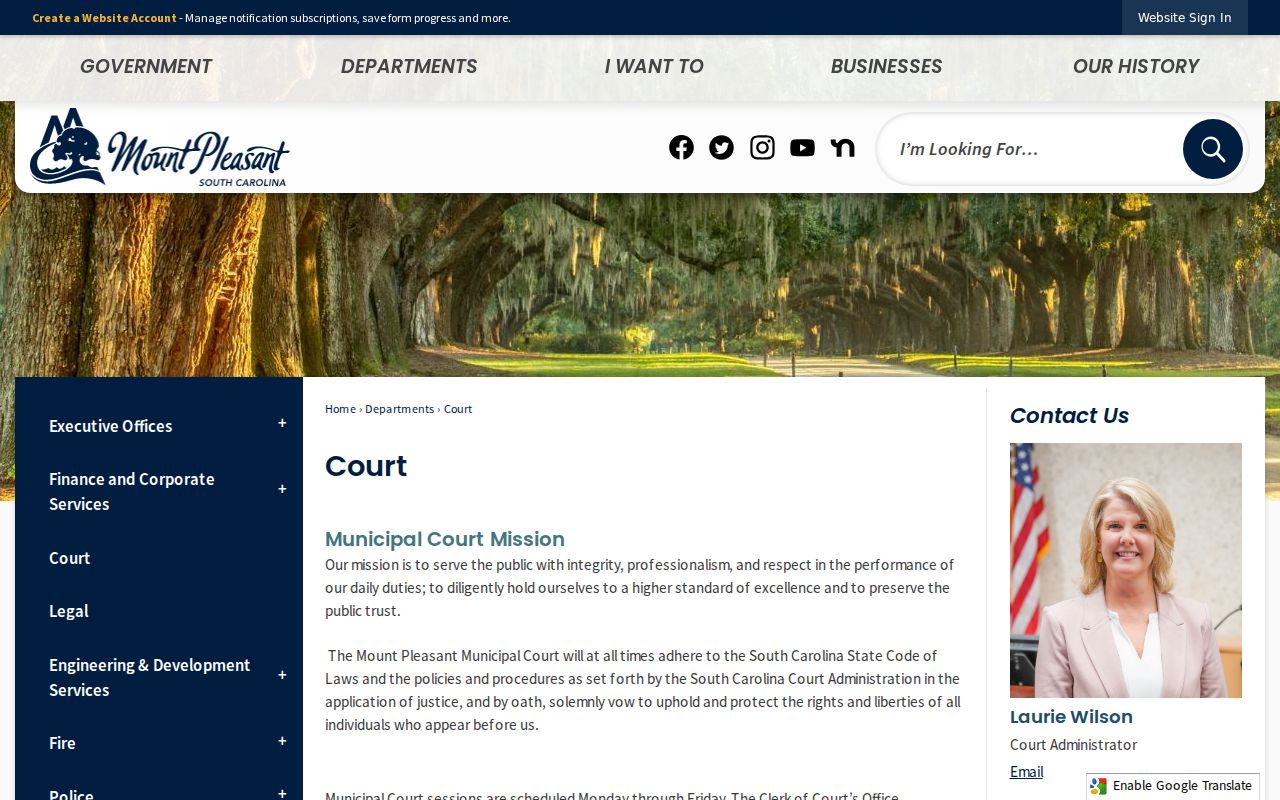
When a citation, summons, or warrant names Mount Pleasant, confirm its docket and disposition with that court rather than assuming the county index is complete.
Charleston County Judicial Center
Clerk of Court, General Sessions
100 Broad Street
Charleston, SC 29401
843-958-2106
Weekdays, 8:30 a.m.-5 p.m.
Note: Security screening applies at the Judicial Center, and courtroom photography needs written approval from the presiding judge.