
Charleston County Arrest History
Charleston County arrest history begins with the agency that took a person into custody. That may be CCSO, Charleston Police, North Charleston Police, Mount Pleasant Police, another municipal department, airport police, a campus public-safety agency, Highway Patrol, SLED, or SCDNR. The arresting agency records the claimed basis, place, time, and report details. Those records are not pooled into one county narrative system.
The Sheriff Al Cannon Detention Center, or SACDC, is the central county booking hub. It creates the booking and inmate numbers, takes an image and fingerprints, records property and classification data, and connects charges with bond and housing fields. A police arrest report, jail booking, court case, and SLED criminal-history cycle can all describe the same event from different angles without being duplicate files.
SACDC Past Booking Search
The official Charleston County inmate search is free and covers current custody. Its “Show Past Bookings” box expands the search to released and prior bookings. Searchers may enter a first and last name, booking or arrest date ranges, or an inmate number up to ten characters. “Enable Sounds Like” helps when name spelling is uncertain, and the search uses reCAPTCHA.
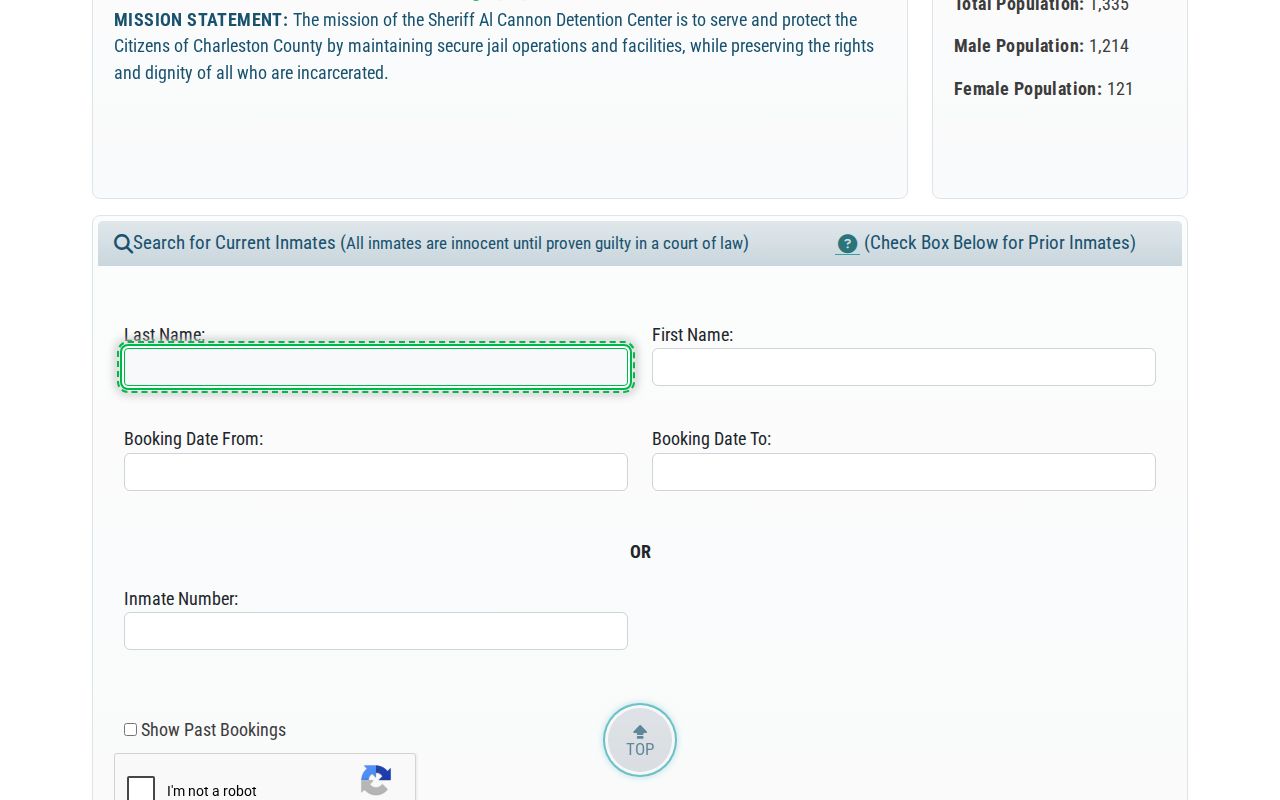
The portal image shows why a zero result must be stated narrowly: the selected dates, spelling choice, current-versus-past scope, and inmate number can all affect what appears.
Start with a tight date range when the arrest date is known. Use Sounds Like for a likely spelling variant. Turn on past bookings for someone who has been released. An absent result is not proof that no arrest occurred. The person may have been booked under different identifiers, transferred to state custody, or processed through a record channel that has not yet reached the search view.
Looking Up Charleston County Arrests
A complete search follows the custody record to its source and outcome. The roster works best for a recent or known county booking. It does not replace the arresting agency's report, the court file, or the statewide repository. Follow these channels in order, changing the first step only when a case or agency number is already known.
- Search the SACDC roster by arrest or booking date, then enable Sounds Like or Show Past Bookings if needed.
- Open the booking detail and note the arresting agency, booking number, agency case or warrant identifier, charges, bond, and custody status.
- Request the underlying arrest report from the agency named in the profile; use CCSO Records or its FOIA process only for a CCSO-created report.
- Search the Charleston Public Index or the issuing municipal court for filed charges and the final disposition.
- Order SLED CATCH for a name-based statewide view, recognizing that it is not national and can lag or miss an unfingerprinted cycle.
- Call the jail, Clerk, or proper agency custodian when an online search is blank, stale, or unclear.
SLED CATCH requires terms acceptance and starts-with matches on last name, first name, and date of birth; it also searches an SSN if supplied. Different identifiers and aliases can create false matches or missed records. Multiple candidates can trigger “Special Processing Required.” CATCH costs twenty-five dollars, plus the current online service fee, and is also available by mail with a stamped return envelope and approved payment. The current “Charleston Co Sheriffs Office” iOS app advertises reports, tips, and safety news, but it does not advertise an inmate, warrant, or registry search. Do not treat the app as an arrest-record channel.
Charleston Arrest Record Custodians
The “Arresting Agency” line in a booking profile identifies the best first route for the incident or arrest narrative. SACDC receiving a person does not transfer ownership of a Charleston Police, Mount Pleasant Police, or campus police report to CCSO. Likewise, a court disposition does not include the full police narrative. A full chronology may require three custodians: the arresting agency, SACDC, and the court.
| Agency | First report route | Follow-through |
|---|---|---|
| Charleston County Sheriff | CCSO Records or Public Information FOIA | SACDC, then the proper county court |
| Charleston Police | CPD Records/Police FOIA at 180 Lockwood | SACDC, then Municipal Court or General Sessions |
| North Charleston Police | City FOIA portal with Police selected | SACDC, then North Charleston court or General Sessions |
| Mount Pleasant Police | MPPD Records or Town Legal | SACDC, then Mount Pleasant court or General Sessions |
| State or special agency | That agency's official records office | SACDC and the court when processed locally |
Charleston Police Records lists 843-720-2412 and a five-dollar ordinary report charge; a victim copy is free with state identification and incident details. The North Charleston FOIA portal is a managed request system, not an instant record search. Mount Pleasant's citizen report portal creates eligible new reports and does not retrieve old arrest records.
Inside a Charleston County Arrest Record
A SACDC profile is a custody snapshot. It can expose one inmate number across time and a separate booking number for each intake. Arrest and booking times may differ. The agency case or warrant identifier points back to the report custodian, while charge and court fields help route the reader toward a filed case. Bond is a release condition at that point, not a fine or a finding of guilt.
| Booking Number | Identifies one intake cycle; one person can have several booking numbers. |
|---|---|
| Booking Date and Time | Shows jail intake, which may occur after the arrest time. |
| Arresting Agency | Names the office that usually owns the incident or arrest narrative. |
| Charges | Lists allegations supplied at booking; later indictment and disposition may differ. |
| Bond | Shows amount, type, and status at that time, not guilt or a court fine. |
| Booking Photo | Shows that a custody image was taken; it proves neither guilt nor current confinement. |
| Release Status | Ends the custody episode but does not end the prosecution. |
The profile may also list name, birth date or age, sex, race, height, weight, housing, a charge description, and court or magistrate information. CCSO warns that some source data comes from the arresting agency or the arrested person and may be inaccurate.
CCSO Self-Check and FOIA
CCSO offers a separate five-dollar local criminal-history check for the subject of the record. It covers only CCSO jurisdiction, reaches no more than twenty years, takes five working days, and is not a complete statewide history. Unclaimed results are destroyed after ten days. Because the form does not clearly settle every submission, identification, and payment detail, confirm current logistics with Records instead of assuming them.
For a CCSO report or a broader sheriff record, first call or visit Records because Public Information says a formal request may not be needed. Written requests go to the Public Information Office at 3691 Leeds Avenue, North Charleston, SC 29405, or PIO@charlestoncounty.org. The request should name the exact documents, agency case number if known, date range, subject and birth date or age, incident location, and other involved people.
CCSO Records Office
3505 Pinehaven Drive
North Charleston, SC 29405
Call or visit first; a formal request may not be needed.
CCSO Public Information
3691 Leeds Avenue
North Charleston, SC 29405
843-554-2495
PIO@charlestoncounty.org
The agency states ten business days for an initial FOIA response, or twenty when records are more than two years old. Those periods concern the determination, not a guaranteed production date. The form lists copies at twenty cents per page, research at no less than twenty-five dollars per hour, media disks at twenty dollars, and broad email searches at seventy dollars. Offsite retrieval and postage may add costs, and a twenty-five-percent deposit may apply to estimates of seventy-five dollars or more. Body-camera data follows a separate rule under S.C. Code §23-1-240(G)(1), while dispatch or 911 recordings belong with Charleston County Consolidated 9-1-1.
Booking Logs and Recent Arrests
Charleston County does not publish a separate general daily booking log. The official inmate and prior-booking search serves that role. Current-custody results can change as people are released or transferred, while the past-bookings option widens the scope to earlier county intakes. The live roster should not be republished as a collection of names or images, and no booking photo proves criminal guilt.
The Sheriff Al Cannon Detention Center page describes the county intake facility and custody services.
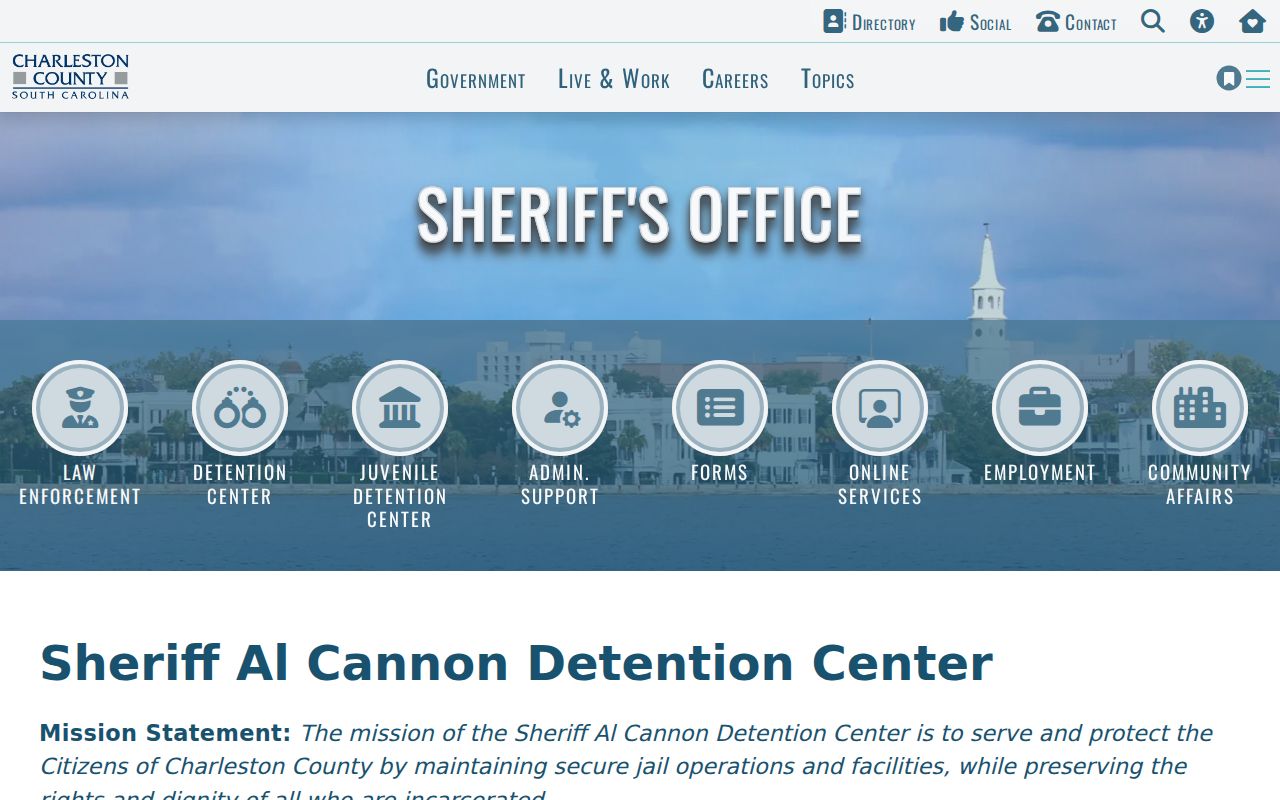
The facility is at 3841 Leeds Avenue in North Charleston and its public number is 843-529-7300, but its roster is only the county-custody layer; the SCDC Inmate Search covers current sentenced state prisoners.
After transfer, a person may disappear from the county current-inmate view while appearing later in the state locator. SCDC does not list county detainees, released people, federal prisoners, or probationers. VINE can support custody notifications, but it is not the official criminal-history repository. Use each tool for its stated scope.
Charleston Warrant Confirmation
A warrant is not a public name-search product in Charleston County. The CCSO Warrants Unit physically controls warrants and juvenile pickup orders received by the Sheriff's Office and verifies whether they are complete and current. Serious warrants receive priority, while other service can depend on reliable location information. Always confirm with the unit or issuing court before travel or surrender.
The official Charleston County warrant page provides direct verification and surrender guidance.
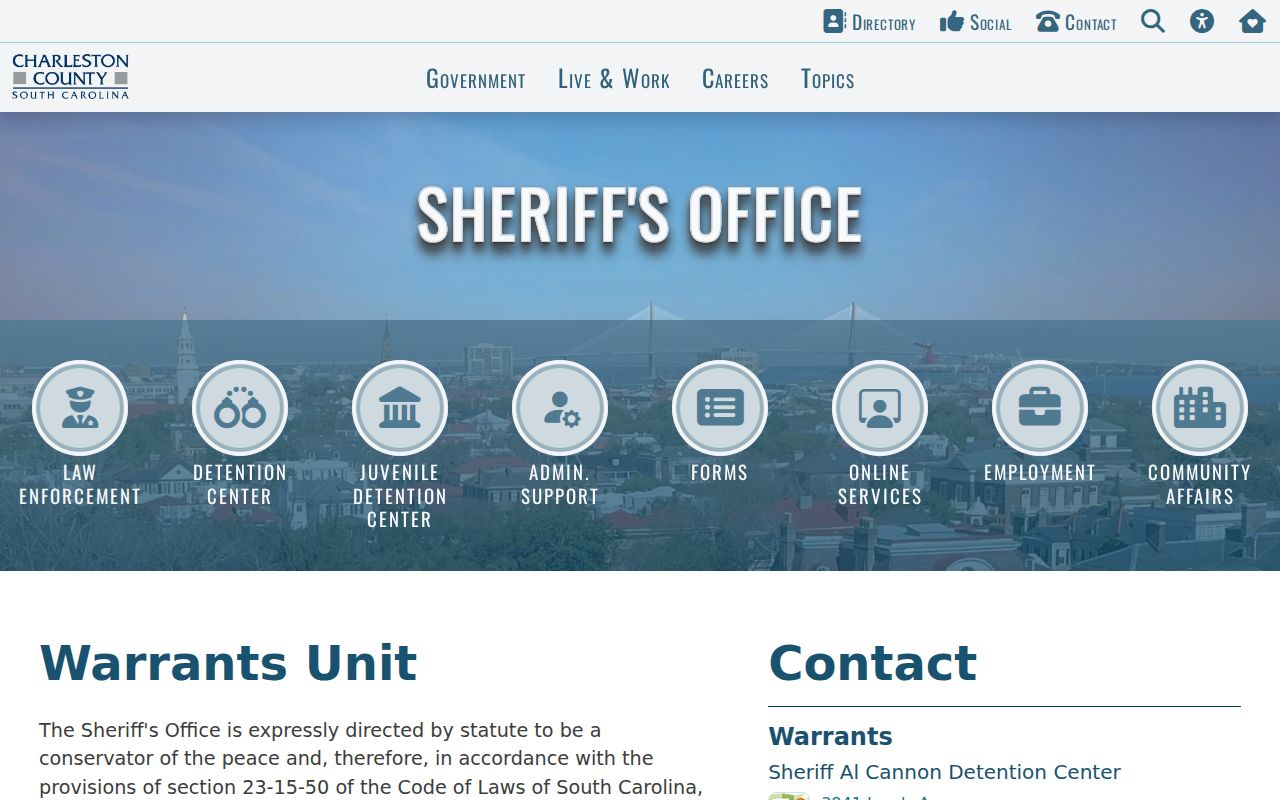
That direct route matters because Charleston County has no public warrant field inventory to search online.
A missed magistrate date should first be checked with that court. Municipal warrants belong with the city court, and probation warrants involve SCDPPPS or the controlling court. Search warrants, sealed indictments, and juvenile process are not public-list products. A warrant recall may also lag across systems after court action, so only the issuing office can settle current status.
Correcting Charleston Booking Records
If a booking profile appears wrong, save the booking number, arresting-agency name, agency identifier, and the field in dispute. Contact CCSO about the jail profile and the arresting agency when the source report supplied the wrong data. If the court outcome is wrong, use the case number and contact the Clerk. A CATCH error follows SLED's challenge process. Each fix belongs with the office that owns that record.
Accurate nonconviction data does not vanish merely because the charge was dismissed. Expungement is a separate legal process. Qualifying General Sessions applications usually go through the Ninth Circuit Solicitor, while a qualifying magistrate or municipal dismissal goes to that court. SLED needs an Order for Destruction of Arrest Records and advises waiting four weeks after receipt before buying a new CATCH report to check removal.
Note: Correcting a data error and expunging an accurate qualifying arrest are separate processes with different proof.
Arrests Are Not Convictions
An arrest record shows that custody and booking occurred based on an alleged offense. A conviction appears only after a court records a finding of guilt. Charges may change between arrest and indictment, and a booking can lead to no filed charge, dismissal, nolle prosequi, or acquittal. Read the Charleston County court disposition before describing an outcome.
| Arrest Record | Conviction Record |
|---|---|
| Created by the arresting agency and jail | Created by the court after adjudication |
| Shows that an arrest and booking occurred | Shows a recorded finding of guilt |
| Lives with the agency and SACDC systems | Lives with the Clerk and reported state repository |
| May end with release or no filed case | May lead to sentence, appeal, or later expungement analysis |
For the filed accusation, motions, plea, and final judgment, use the Charleston County criminal court case record. CATCH may later reflect the arrest and reported outcome, but missing prints, data mismatches, and reporting lag can leave gaps between sources.
Note: A Charleston County arrest is not proof of guilt, and many bookings do not end in a conviction.